
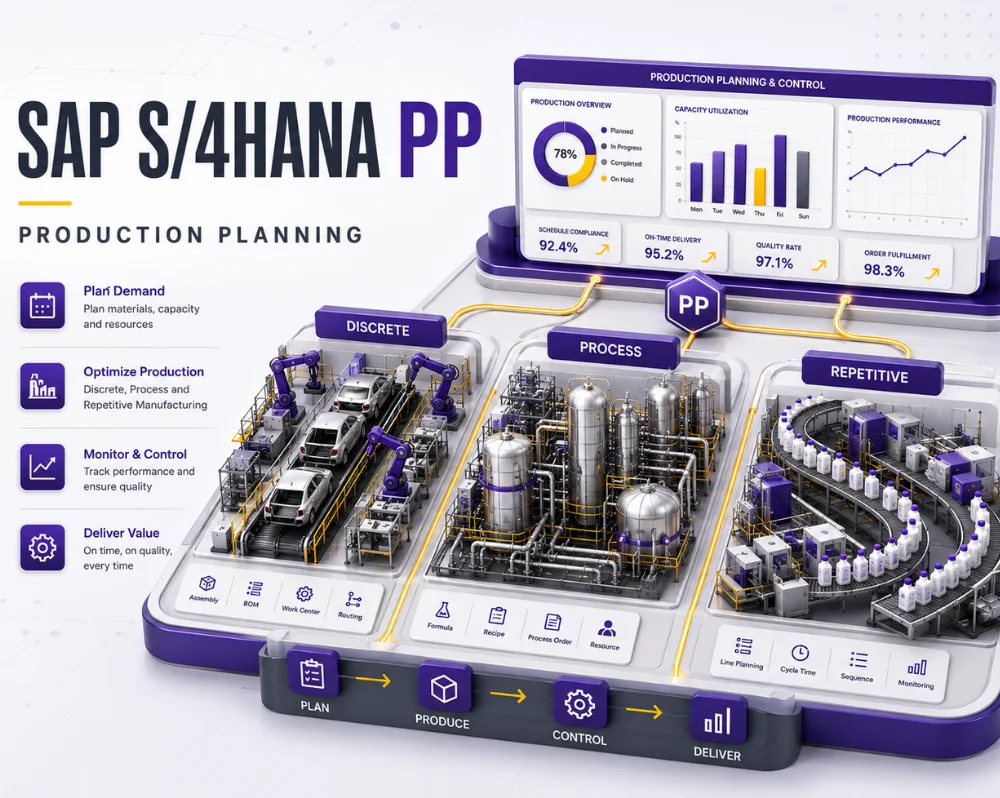
SAP Production Planning (SAP PP) is a core logistics module designed to align an organization's manufacturing capacity with market demand. Training in this module equips professionals with the skills to plan, execute, and monitor the entire manufacturing lifecycle. It ensures that materials are available when needed, production bottlenecks are minimized, and shop-floor operations run efficiently.
Key skills and concepts covered throughout this course.
7 outcomes
Discrete Manufacturing: Focuses on order-based production where products change frequently and can be individually tracked or disassembled (e.g., machinery, automobiles, heavy equipment). Training emphasizes standard production orders, routings, and component staging.
Process Manufacturing (PP-PI): Designed for batch-oriented industries where products are manufactured in continuous processes and cannot be disassembled once mixed (e.g., pharmaceuticals, chemicals, food and beverage). Key topics include master recipes, process orders, and PI (Process Instruction) sheets for strict compliance.
Repetitive Manufacturing (REM): Ideal for the continuous, high-volume mass production of identical products over a set period (e.g., consumer goods, electronics). Training highlights period-based production planning, rate routings, run schedules, and simplified backflushing.
Master Data Management: Configuring complex Bills of Material (BOM), Work Centers/Resources, Routings/Recipes, and Production Versions.
Sales and Operations Planning (S&OP): Forecasting long-term production targets based on historical sales data and projected market trends.
Material Requirements Planning (MRP): Translating demand into actionable planned orders to ensure material availability without tying up capital in excess inventory.
Capacity Planning: Evaluating and leveling work center capacities to identify and resolve scheduling bottlenecks prior to execution.
Course Contents
Introduction to Production Planning in SAP S/4HANA
Production Planning Overview
Characteristics of Production Types
Processes in Production Planning and Control
Product Cost Controlling
Organisational Structure in SAP
Breaking down the structure into units
SAP Calendar
Discrete Manufacturing Configuration
Material Master
Bill of Materials
Work Center
Routing
Production Order Configuration
Order Type Dependent Plant Parameters
Production Scheduling Profile
Default Values for the Generation of Operations
Availability Check
Scheduling
Reduction Strategy
Confirmation
Process Manufacturing Configuration
Master Data in Process Industries
Order Type Dependent Parameters
Production Scheduling Profile
Process Management
Process Messages
Process Instruction Category
Control Receipt/Process Instruction Sheets
Repetitive Manufacturing Configuration
Repetitive Manufacturing Profile
Scheduling Planned Orders
Material Staging
Operational Methods Sheet
Production Planning for Discrete Manufacturing
Process Overview
Master Data
Production Order Management
Release Production Order
Material Withdrawal
Confirmation
Goods Receipt
Postprocessing
Settlement and Completion
Production Planning for Process Manufacturing
Process Manufacturing Overview
Master Data in Process Manufacturing
Characteristics
Process Management
Process Order Execution
Process Management in Action
Execution Steps
Production Planning for Repetitive Manufacturing
Overview
Master Data
Material Requirements Planning in REM
Planning Table
Material Staging
Production List
Confirmation
Reversals and Scrap
Costing Activities
Batch Management
Batch Management Overview
Batch Level and Batch Status Management
Master Data in Batch Management
Business Processes in Batch Management
Batch Determination
Recurring Inspection and Expiration Dates
Batch Derivation
Batch Traceability of Work in Process Batches
Sales and Operational Planning
Standard Sales and Operational Planning
Flexible Planning
Version Management
Forecasting
Rough-Cut Planning Profile
Events
Mass Processing in Sales and Operational Planning
Demand Management
Elements of Demand Management
Strategies for Make-to-Stock Production
Strategies for Make-to-Order Production
Strategies for Assemble-to-Order
Strategies for Planning Components
Production with Variant Configuration
Create Custom Requirement Class
Business Processes in Demand Management
Foundations of Material Requirements Planning
Process Overview
Deterministic Replenishment Procedures
Stochastic Replenishment Procedures
Configuring Material Requirements Planning Types
Lot Sizing Procedures
Rounding
Scrap
Safety Stock
Scheduling
Procurement Proposals
Configuration Settings for Material Requirements Planning
Running Material Requirements Planning
MRP Live
Stock/Requirements List
Planning Calendar
Planning Areas
Classis Material Requirements Planning
Types of Planning Runs
Demand-Driven Replenishment
Long-Term Planning
Long-Term Planning Master Data and Planning Data
Long-Term Planning: Business Process
Additional Features in Long-Term Planning
Evaluate Information Systems
Capacity Requirements Planning
Process Overview
Capacity Requirements and Capacity Evaluation
Finite Scheduling
Dispatching
Capacity Planning Table
Production Planning and Detailed Scheduling
Configuration
Master Data in PP-DS
Business Processes
Heuristics
Production Planning Run
Reporting and Monitoring Apps
Alert Monitor
Plan Monitor
Early Warning System
Overview
Exceptions
Set Up Periodic Analysis
Schedule an Early Warning System
Triggering an Early Warning System
Exception Analysis
Production Planning Reporting
Basics of Reporting
Report Parameters
Order Information System Reports
Missing Parts Information System
Standard Planning Analysis
Discrete Manufacturing/Production Order
Process Manufacturing/Process Order
Repetitive Manufacturing
Before you begin
Course requirements
Review the recommended knowledge and tools before joining.
5 requirements
Background: Experience in Production Planning, Production Management, Production Processing
Qualifications: Production Manager, Shop Floor Manager, Production Planning Engineer, Production Planning Manager
Experience Level: Recent graduates to experienced professionals
Key Markets: APAC, MENA, EMEA, and the US (All Regions)
Industries: Oil and Gas (Upstream, Midstream, Downstream), Manufacturing and Production, Distribution, Retail, Utilities, Defence