


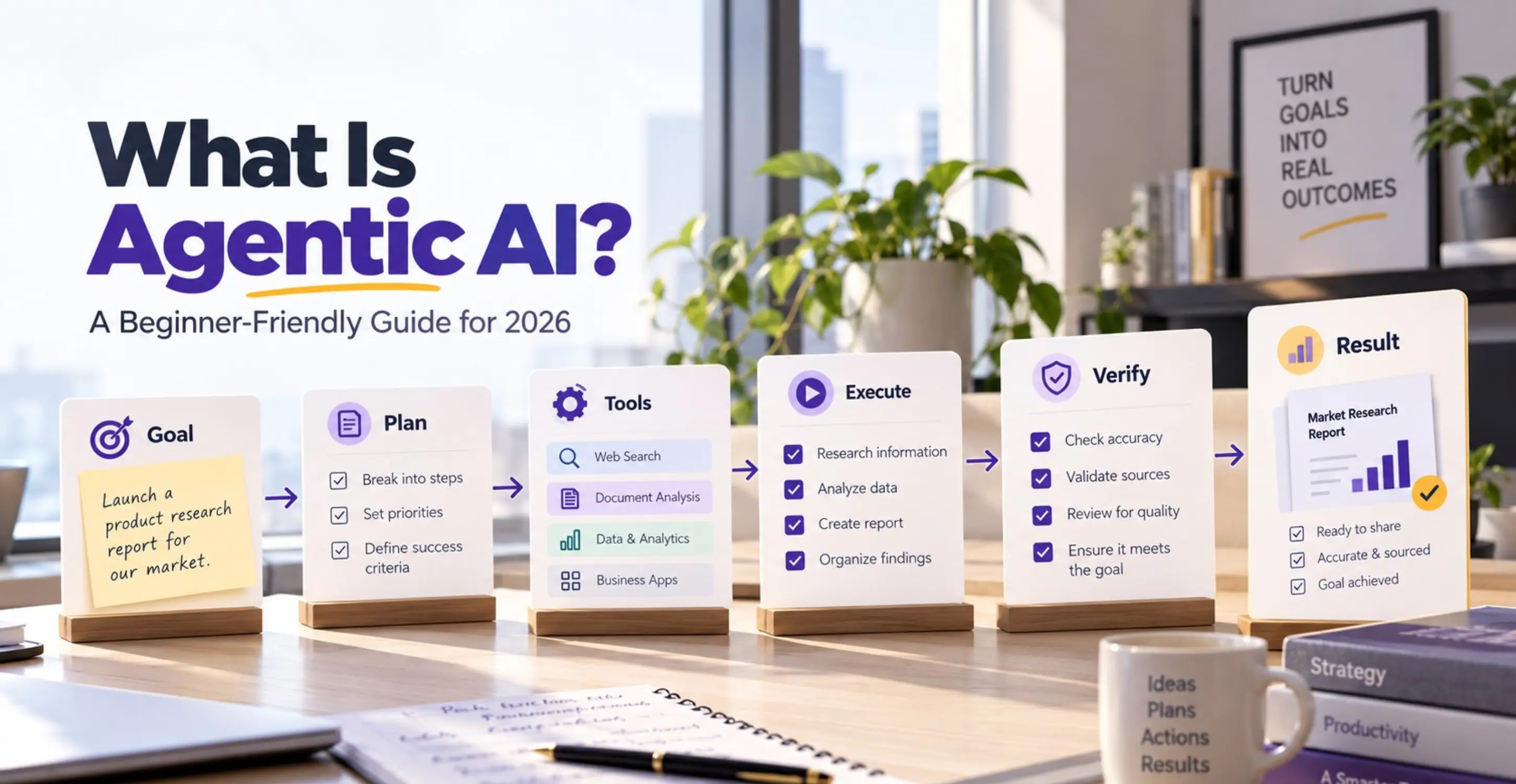
What Is Agentic AI? A Beginner-Friendly Guide for 2026
Imagine asking an AI assistant to organize a meeting. It writes an invitation, suggests an agenda, and tells you how to schedule it. You still have to check everyone's availability, create the calendar event, and send the invitations.
Now imagine an AI system that can perform those steps using connected applications, check whether its actions succeeded, and ask for your approval before sending anything.
That is the practical idea behind agentic AI.
Agentic AI combines artificial intelligence with the ability to plan tasks, use tools, retrieve information, and take actions toward a defined objective. Rather than simply generating a response, an appropriately designed AI agent can help carry out a multi-step process.
But how does it actually work? Is it different from ChatGPT? Can businesses trust AI agents to perform tasks independently?
This guide explains agentic AI in straightforward language, with practical examples, real industry deployments, the technology behind AI agents, and a learning pathway for beginners in 2026.
What Is Agentic AI? A Simple Explanation
Agentic AI is an approach to artificial intelligence in which AI-powered systems can work toward defined goals by selecting actions, using available tools, responding to new information, and carrying out tasks within established permissions and boundaries.
The important distinction is the ability to act toward an objective, rather than only produce information.
Consider a workplace example.
You tell an AI system:
"Arrange a project review meeting with my team next week and prepare an agenda based on our latest project updates."
A conventional text-generation interaction might produce an agenda and instructions for organizing the meeting.
An appropriately connected AI agent could potentially:
-
Access your calendar and check available meeting slots.
-
Review authorized project documents to identify discussion topics.
-
Find a suitable meeting time.
-
Prepare the meeting invitation and agenda.
-
Request your approval before contacting participants.
-
Create the calendar event through an authorized integration.
-
Report which actions were completed.
The agent is still software. It does not possess human intentions or unlimited independence. Its capabilities depend on the model, tools, integrations, instructions, permissions, and controls provided by its developers and users.
Google Cloud describes agentic AI in terms of autonomous decision-making and action, while Anthropic's engineering guidance distinguishes agents that dynamically select their actions from workflows that follow predetermined sequences.
Both perspectives help explain the same underlying development: AI systems can increasingly participate in executing work, not simply discussing it.
What Is an AI Agent?
An AI agent is a software system designed to pursue a specific goal by interpreting information, choosing permitted actions, interacting with available tools, and evaluating the results.
An AI agent commonly combines several components:
| Component | What it does |
|---|---|
| Goal | Defines what the system is trying to accomplish |
| Instructions | Establish responsibilities, rules, and limits |
| AI model | Interprets information and helps select actions |
| Context | Provides relevant information about the task |
| Tools | Connects the agent to available functions and systems |
| Execution process | Coordinates actions and their results |
| Observations | Supplies feedback from completed tool calls |
| Stopping conditions | Determines when to finish, pause, or escalate |
| Human controls | Require approval or intervention when necessary |
Agentic AI is the broader approach to building systems around goal-directed behavior. An AI agent is an individual implementation of that approach.
A single AI agent might manage customer enquiries. A larger agentic system might coordinate several specialized agents handling research, documentation, and reporting.
Not every agent needs permanent memory, multiple models, or a complex planning system. A relatively simple agent can be useful when it has a clearly defined task and an appropriate set of tools.
Agentic AI vs Generative AI: What's the Difference?
Generative AI and agentic AI are closely related, but they emphasize different capabilities.
Generative AI focuses on producing content or information. Agentic AI focuses on using AI capabilities to pursue goals and perform tasks.
Generative AI can produce text, images, code, audio, and other outputs. Agentic systems can use generative models as part of a larger process involving decisions, external information, and actions.
| Feature | Generative AI | Agentic AI |
|---|---|---|
| Primary purpose | Generate or transform information | Work toward a goal |
| Typical input | Prompt or instruction | Objective, context, and constraints |
| Typical output | Text, code, images, or analysis | Task results, actions, and summaries |
| Tool use | Available in some applications | Commonly central to execution |
| External actions | Possible in tool-enabled systems | Often an important capability |
| Decision flexibility | Depends on the application | Can choose among permitted next steps |
| Task complexity | Single or multiple interactions | Often coordinates several steps |
| User involvement | Frequently prompt-driven | May operate between approval checkpoints |
| Example | Draft a customer email | Research an enquiry, draft a response, and update a CRM after approval |
| Main limitation | Accuracy and output quality | Accuracy, action reliability, permissions, and operational risk |
The categories overlap.
A generative AI model may be the reasoning and language-processing component of an AI agent. Modern AI assistants can also provide tool access and agent-like workflows.
A useful question is not simply whether an application uses generative AI. It is whether the surrounding software allows the AI to make bounded choices and execute meaningful steps toward completing a task.
AI Agents vs Chatbots vs Traditional Automation
An AI agent is not the same as every chatbot or automated workflow.
To understand the difference, consider a customer asking an online retailer for a refund.
| Technology | How it handles the refund request | Decision-making and control |
|---|---|---|
| Traditional automation | Checks fixed eligibility rules and follows programmed steps | Predetermined rules |
| AI chatbot | Explains the refund policy and answers questions | Primarily conversational |
| AI-assisted workflow | Classifies the request and prepares a refund recommendation for staff | AI assists within a controlled process |
| AI agent | Checks authorized order records, investigates the request, selects an appropriate next step, and proposes or initiates permitted actions | Flexible decisions within defined constraints |
Traditional automation is highly effective when the process is predictable.
For example, software can automatically issue a confirmation whenever a customer submits a completed form. No language model is necessary.
A chatbot becomes useful when the customer needs conversational explanations.
An AI-assisted workflow may help interpret complicated requests while leaving the process itself under explicit software control.
An agent becomes more relevant when requests vary, several information sources are involved, or the next action depends on what the system discovers.
Even then, issuing a refund may require an established financial policy or human authorization. Giving an agent access to payment systems does not automatically make unrestricted financial actions appropriate.
Anthropic's Building Effective Agents recommends beginning with simpler solutions and adding agentic complexity only when the task justifies it.
How Does Agentic AI Work?
Most modern agentic AI systems use some form of repeated interaction between an AI model, available tools, and the environment.
This is commonly called an agentic loop.
A simplified agentic AI execution loop follows this sequence:
Receive Goal → Understand Context → Plan Next Action → Select Tool → Execute Action → Observe Result → Evaluate Progress → Continue, Request Approval, or Stop
The system may repeat parts of this cycle until the objective is achieved, an execution limit is reached, or human intervention becomes necessary.
Step 1: Receive a Goal
The system receives an objective such as:
"Find all unpaid invoices from last month and prepare a follow-up report."
The agent must understand the requested outcome and any restrictions.
Step 2: Understand the Context
The agent identifies what information it needs, which records are relevant, and what tools it can use.
In this example, it might need access to an accounting database and an approved report template.
Step 3: Plan or Select the Next Action
The model chooses an appropriate next step. It might decide to retrieve outstanding invoices before generating the report.
Planning can be explicit or relatively lightweight, depending on the implementation.
Step 4: Choose an Available Tool
The agent selects a permitted function, such as querying the accounting system.
This is often implemented through an application programming interface (API), which allows software systems to exchange information and request operations.
Step 5: Execute the Permitted Action
The surrounding application executes the tool call using its configured authentication and permissions.
The model itself does not gain unrestricted access to the accounting system.
Step 6: Observe the Result
The tool returns information, such as invoice numbers, amounts, due dates, and payment statuses.
The agent uses that result to decide what should happen next.
Step 7: Evaluate Progress
The agent checks whether it has enough information to complete the report.
If records are missing or a request fails, it may retry, use an authorized alternative, or ask for help.
Step 8: Continue, Request Approval, or Stop
The system may create a draft report, request approval before sending payment reminders, or stop when the task is complete.
Developers can set limits on execution steps, spending, tool access, and other operations.
This sequence is a simplified explanation rather than a universal architecture. The foundational ReAct research, published at ICLR 2023, helped establish how language models can alternate between generating actions and incorporating environmental feedback.
The Technology Behind AI Agents
AI agents combine several existing technologies into coordinated software systems. Understanding these components makes the concept less mysterious.
1. Large Language Models (LLMs)
Large language models process and generate language and can support tasks such as interpreting instructions, analyzing documents, producing structured outputs, and selecting tools.
Models such as Claude, GPT, and Gemini can serve as components of agentic applications.
The model does not necessarily run the entire application. Software around the model manages tool execution, authentication, task state, errors, and approvals.
2. Tools, APIs, and Integrations
Tools allow an AI agent to perform operations beyond generating text.
For example, an agent may have access to functions that retrieve CRM records, search documents, query a database, or prepare an email.
An API defines how another software service can be accessed. The agent selects a function, while the application controls whether and how it runs.
Research such as Toolformer: Language Models Can Teach Themselves to Use Tools, published at NeurIPS 2023, explored how language models can learn to incorporate external tools into their processing.
3. Planning and Orchestration
Planning concerns how a system decides what to do next. Orchestration concerns how the wider application coordinates models, tools, workflows, and execution.
A customer-service agent might first verify an order number, then check delivery records, and finally determine whether escalation is necessary.
Some systems follow fixed sequences. Others allow the model to select steps dynamically.
4. Context and Memory
Context is the information currently available to the model, including instructions, conversation history, and retrieved data.
Memory refers to mechanisms for retaining or recovering information that may be useful later.
An agent working on a project might maintain a record of which documents it has reviewed. Another application might store approved user preferences between sessions.
Persistent memory is optional. Many agents can complete useful tasks without keeping long-term information.
5. Retrieval-Augmented Generation (RAG)
Retrieval-Augmented Generation, or RAG, allows an application to retrieve relevant information from external sources and provide it as context for a model.
Suppose a customer asks about a product warranty.
Instead of relying only on its training, an AI agent could retrieve the current warranty policy from an authorized document collection.
RAG can help make responses more relevant to current company information. It does not guarantee accuracy, and the retrieved documents still need to be trustworthy.
6. Model Context Protocol (MCP)
The Model Context Protocol is a standardized way for AI applications to connect with tools, resources, and other external capabilities.
For example, an MCP-compatible application may connect to an authorized file service or business tool through an MCP server.
MCP defines communication mechanisms between participating components. It is not itself a language model or an AI-agent framework.
The official MCP documentation explains how AI applications use the protocol to exchange context and access integrations.
7. Guardrails and Permissions
Guardrails are technical and procedural controls that limit agent behavior.
Examples include allowing an agent to read customer records but not delete them, restricting which websites it can access, validating tool inputs, and preventing actions outside an approved task.
Permissions should be enforced by the connected systems, not merely requested in a prompt.
8. Human-in-the-Loop Controls
Human-in-the-loop design introduces human review or approval during automated operations.
An agent might prepare a supplier purchase order but require a manager to authorize it before submission.
This is particularly important for actions involving money, sensitive information, legal obligations, or material business consequences.
9. Evaluation and Monitoring
Agent evaluation means testing whether the system completes tasks correctly, follows instructions, respects permissions, and handles failures.
Developers may measure task completion, inappropriate actions, escalation accuracy, tool errors, operating costs, and latency.
The need for realistic evaluation is reflected in academic benchmarks such as AgentBench and SWE-bench, which assess agent-like performance in interactive environments and software engineering tasks.
A system that produces impressive demonstrations is not necessarily reliable enough for operational use.
A Practical Example of Agentic AI in Action
Consider a small business receiving customer enquiries through email and its website.
The company wants to respond efficiently without allowing AI to make unauthorized promises, share confidential information, or issue refunds.
It builds a supervised customer-enquiry agent.
| Step | What the agent does | Technology involved | Human control |
|---|---|---|---|
| 1 | Receives an incoming enquiry | Authorized email or website integration | Access restricted to approved channels |
| 2 | Identifies what the customer needs | Language model | Classification can be reviewed |
| 3 | Searches the company knowledge base | Document search or RAG | Approved information sources |
| 4 | Retrieves relevant product details | Database or CRM API | Read-only permissions |
| 5 | Prepares an appropriate response | Language model | Follows approved communication policies |
| 6 | Checks for unusual or sensitive requests | Business rules and AI classification | Escalation criteria |
| 7 | Requests approval when required | Workflow system | Staff reviews consequential actions |
| 8 | Sends an authorized response | Email or messaging API | Sending permissions and approval rules |
| 9 | Updates the customer record | CRM integration | Restricted write access |
| 10 | Reports the outcome | Execution log | Staff can review the activity |
Suppose a customer asks whether a particular product is compatible with equipment they already own.
The agent searches the product documentation. If the specifications clearly confirm compatibility, it can prepare an informed answer.
If the documentation is incomplete, the agent should not invent a technical guarantee. It should ask for additional information or refer the enquiry to a qualified employee.
This is an illustrative workflow, not a claim about a particular company's deployment.
It demonstrates what makes agentic AI useful: the system can coordinate several operations while respecting boundaries, monitoring results, and involving people where appropriate.
Real-World Examples of Agentic AI in 2026
Agentic AI is already being used in customer service, software development, and enterprise operations. The following examples come from published customer case studies rather than hypothetical product demonstrations.
The reported results are supplied by the organizations and their technology vendors. They should be understood as case-specific outcomes, not independent evidence that every business will achieve similar results.
1. Tally Group: AI Agents in Utility Customer Service
Australian utility technology provider Tally Group developed Adora AI using Google Cloud's Gemini technology.
Its multi-agent system helps service teams investigate billing enquiries, retrieve customer usage information, and identify issues across connected systems.
According to Google Cloud's Tally Group case study, the company reduced average call-handling times from approximately 20 minutes to less than four minutes. Another component scans bills and directs exceptions to human reviewers.
The example demonstrates how specialized agents can coordinate information retrieval and business processes while retaining human control over exceptions.
2. Ramp: Agentic AI for Software Engineering
Financial technology company Ramp adopted Claude Code to support engineering activities such as software implementation, testing, and incident investigation.
Engineers connected Claude Code to development tools and internal systems. This allowed it to work with code, obtain technical context, and support multi-step development tasks.
In Anthropic's Ramp case study, Ramp reports implementing more than one million lines of AI-suggested code over 30 days, with roughly half of its engineering organization using Claude Code weekly.
The company also describes internal incident-investigation tooling associated with reductions of up to 80% in investigation time.
These are vendor-published, company-reported outcomes. They do not establish the quality of every generated line of code or prove an equivalent productivity gain for other engineering teams.
3. AIHelp: Multilingual Customer Support Agents
AIHelp develops customer-service technology for gaming companies operating across multiple markets.
Its agentic customer-support systems use language models, knowledge retrieval, translation, and response evaluation to handle enquiries in different languages.
According to Google Cloud's AIHelp case study, customers using the updated system experienced reported satisfaction improvements of 5% to 10%, while the company's development process for multilingual AI models required substantially less time.
The system also incorporates retrieval and evaluation mechanisms intended to improve response relevance.
This example illustrates how AI agents can combine language understanding with specialized information systems, rather than relying on conversational ability alone.
4. TELUS: Connected AI for Customer Operations
Telecommunications company TELUS has developed AI-powered customer-experience processes using Google Cloud services.
The system combines customer-interaction data, analytics, AI-generated guidance, and agentic capabilities to investigate problems and support more proactive service.
Google Cloud's TELUS customer case study reports that 30% of customer calls are resolved proactively with AI agents, alongside faster customer-issue resolution.
The important lesson is that an enterprise agent often depends on well-organized data, secure integrations, and operational workflows. The AI model is only one part of the system.
Agentic AI Use Cases Across Industries
Not every organization needs the same type of agent. The value depends on the task, available systems, reliability requirements, and level of permitted automation.
| Business function | Potential agentic AI use case | Required systems | Oversight |
|---|---|---|---|
| Customer service | Investigate enquiries and prepare resolutions | CRM, knowledge base | Approval for refunds and exceptions |
| Sales | Research leads and update opportunity records | CRM, approved research tools | Review before external contact |
| Marketing | Coordinate research and campaign preparation | Analytics, content systems | Brand and campaign approval |
| Finance | Investigate invoice discrepancies | Accounting software, documents | Financial review |
| Human resources | Assist with onboarding and policy enquiries | HR platform, policy documents | Privacy and employment oversight |
| Procurement | Investigate supplier information and purchase exceptions | ERP, supplier records | Approval for purchasing decisions |
| Supply chain | Identify inventory exceptions and recommend next steps | ERP, inventory systems | Review for consequential changes |
| Healthcare | Support administrative documentation workflows | Authorized clinical systems | Privacy controls and professional supervision |
| Software development | Investigate issues, modify code, and run tests | Repositories, development tools | Code review and testing |
| IT operations | Investigate alerts and propose remediation | Monitoring and service-management tools | Approval for system changes |
| Research | Collect evidence and prepare referenced summaries | Search and document tools | Source verification |
These are possible implementations, not a claim that all have reached widespread production maturity.
An organization should establish clear success criteria before developing an agent. For customer service, that might involve correct resolution rates and escalation accuracy. For finance, it might involve reconciliation accuracy and the proportion of exceptions requiring human review.
Single-Agent vs Multi-Agent Systems
A single-agent system uses one agent to manage an objective. That agent may call several tools and perform many steps.
A multi-agent system divides work among multiple agents, often with specialized responsibilities.
For example, a financial-reporting system might assign separate responsibilities to an information-retrieval agent, an analysis agent, and a report-preparation agent.
Multiple agents can be useful when a task naturally separates into distinct responsibilities.
However, they introduce additional coordination, latency, debugging, and cost considerations.
A multi-agent architecture is not automatically better than a carefully designed single agent.
Popular Agentic AI Tools and Frameworks in 2026
Building AI agents does not require inventing every software component from scratch. Several established platforms provide tools for model interaction, integration, orchestration, and evaluation.
| Technology | What it supports | Typical audience |
|---|---|---|
| OpenAI Agents SDK | Agent development, tool use, orchestration, and execution controls | Developers |
| Claude Agent SDK | Building agent applications using Claude's agent capabilities and tools | Developers |
| LangGraph | Stateful workflows, execution graphs, persistence, and human intervention | Developers and AI engineers |
| Microsoft Agent Framework | Building agents and coordinated workflows using supported models and integrations | Enterprise developers |
| Google Agent Development Kit | Agent development, tool integration, multi-agent coordination, and evaluation | Developers |
| Amazon Bedrock AgentCore | Infrastructure and services for deploying and operating agents | AWS developers and platform teams |
Most of these are development-oriented technologies, so programming is generally involved. Some products built on related platforms provide visual configuration or low-code interfaces.
Tool availability also changes. For example, Microsoft's current Agent Framework succeeds earlier Semantic Kernel and AutoGen approaches, while AWS's original Bedrock Agents offering has transitioned to a Classic offering that is no longer open to new customers.
Beginners should choose a technology based on the problem they want to solve, not on the number of agents or integrations a framework advertises.
What Are the Benefits of Agentic AI?
When appropriately designed, AI agents can offer several operational benefits.
They may reduce manual coordination between software systems, assist employees with information-heavy processes, and handle repetitive multi-step tasks.
They can also support research, make relevant information easier to access, and help organizations respond to changing inputs without requiring a rigid script for every situation.
The benefits are not automatic.
In McKinsey's 2026 State of AI survey, 40% of respondents at organizations with annual revenues above $1 billion reported scaling AI agents, compared with 22% at smaller organizations. These figures reflect survey responses about adoption rather than verified operational success.
The same research found that organizations still face difficulties turning AI adoption into broad financial benefits.
A useful agent should be judged by its actual task performance, total cost, failure rate, and value to users.
Limitations, Risks, and Challenges of Agentic AI
AI agents can make mistakes. Their ability to take actions makes some mistakes more consequential than an incorrect chatbot answer.
Incorrect Information and Decisions
Language models may generate incorrect information or misinterpret instructions.
An agent could misunderstand a customer request, select an inappropriate next step, or produce an incorrect summary from incomplete records.
Retrieval, validation, and human review can reduce these risks, but cannot eliminate them.
Prompt Injection
Prompt injection occurs when untrusted content contains instructions intended to manipulate an AI system.
For example, a document retrieved by an agent might include malicious text asking the system to reveal confidential information.
The agent should treat that document as information to analyze, not as an instruction source with authority over its behavior.
Excessive Permissions and Unauthorized Actions
An agent given more access than necessary can create unnecessary risk.
A reporting assistant generally should not need unrestricted database deletion privileges.
Permission controls, limited credentials, approval checkpoints, and activity logs help contain the consequences of errors or misuse.
Tool Failures and Unreliable Execution
APIs may fail, records may be outdated, and connected applications may respond unexpectedly.
Long tasks can also produce compounding errors when an agent relies on inaccurate intermediate results.
Reliable systems need error handling, retry limits, stopping conditions, and recovery mechanisms.
Privacy, Cost, and Governance
Agents may process sensitive records, incur model and tool usage costs, or interact with systems subject to regulatory obligations.
Developers need to address authentication, data access, logging, retention, performance, and accountability.
The OWASP Top 10 for Agentic Applications 2026 provides security guidance specific to agentic systems. The NIST AI Risk Management Framework offers broader guidance for identifying and managing AI risks.
Responsible agent design starts by defining what a system is allowed to do, what it must never do, and when a human must intervene.
When Should You Use an AI Agent and When Shouldn't You?
An AI agent is useful when a task needs flexible decisions, multiple information sources, or several connected actions.
It is usually unnecessary when a simpler, predictable solution performs the work reliably.
| Business need | Better starting approach | Reason |
|---|---|---|
| Calculate a tax percentage | Traditional software | Deterministic calculation |
| Send a reminder at a fixed time | Rule-based automation | Known schedule and action |
| Write a product description | Standard generative AI | Primarily content generation |
| Extract fields from standardized invoices | Document-processing workflow | Predictable input and output |
| Classify varied support enquiries and prepare replies | AI-assisted workflow | Flexible interpretation with fixed controls |
| Investigate complex customer cases across several systems | Supervised AI agent | Variable information and multiple actions |
| Research a technical issue, inspect files, and test possible fixes | AI agent | Adaptive multi-step execution |
Before choosing an agent, ask whether the task genuinely requires model-directed decisions.
If the same objective can be achieved through a straightforward database query or a stable automation rule, that approach may be cheaper and easier to maintain.
Do You Need Coding Skills to Learn Agentic AI?
You do not need programming experience to understand agentic AI or begin using existing agent-enabled applications.
However, there is an important distinction between understanding AI agents and engineering reliable custom systems.
| Learning objective | Coding requirement |
|---|---|
| Understand agentic AI concepts | Not required |
| Use existing agent-enabled products | Often not required |
| Create basic no-code AI workflows | Often minimal |
| Connect custom APIs and tools | Commonly required |
| Build custom agent applications | Usually beneficial |
| Deploy secure enterprise systems | Strong software engineering knowledge recommended |
Python is a practical language for learning agent development because many AI libraries and examples support it.
Developers also benefit from understanding APIs, authentication, JSON, databases, testing, and debugging.
Beginners do not need to master all these subjects before starting. They can build their knowledge incrementally.
How to Start Learning Agentic AI in 2026
A structured learning pathway is more useful than immediately experimenting with complex multi-agent frameworks.
Stage 1: Understand Generative AI Fundamentals
Learn what large language models do, how prompts work, and why model outputs require verification.
Stage 2: Study the Agentic Loop
Understand goals, context, planning, tools, feedback, and stopping conditions.
Stage 3: Learn the Basics of APIs and Integrations
Focus on how software exchanges information and how permissions work.
Stage 4: Practice With Simple Workflows
Start with reading approved data, classifying information, and producing structured outputs.
Stage 5: Build a Small Agent
Choose one narrow objective with a measurable outcome, such as investigating a set of sample customer enquiries.
Stage 6: Introduce Evaluation and Safety
Test correct results, unusual inputs, failures, and unauthorized-action attempts.
Stage 7: Explore Advanced Concepts
Add RAG, persistent memory, MCP, orchestration, or specialized agents when the project requires them.
For readers who want a guided approach, AI Prompt Engineering at Avision Trainings provides a relevant starting point for developing stronger foundational prompting skills before progressing to agent-building topics.
Learning frameworks and tools is important, but understanding why an agent should take a particular action is equally valuable.
Three Beginner-Friendly Agentic AI Projects
Project 1: AI Research Assistant
Goal: Gather information on a defined topic and organize findings into a referenced report.
The agent uses approved search tools, collects relevant sources, extracts information, and prepares a structured summary.
Difficulty: Beginner to intermediate.
Learning outcomes: Information retrieval, tool use, source attribution, and output validation.
Safety precaution: Require sources for factual claims and have the user review findings before relying on the report.
Project 2: Customer Enquiry Assistant
Goal: Process sample customer enquiries and prepare useful draft responses.
The agent classifies each request, searches an approved knowledge base, identifies missing information, and prepares a response.
Difficulty: Intermediate.
Learning outcomes: Classification, RAG, workflow design, escalation, and structured outputs.
Safety precaution: Use fictional customer data and require approval before messages are sent.
Project 3: Personal Task Organizer
Goal: Turn a collection of tasks into an organized work plan.
The agent reviews authorized task information, identifies priorities, proposes schedules, and prepares suggested calendar actions.
Difficulty: Intermediate.
Learning outcomes: API integration, state management, planning, and permissions.
Safety precaution: Begin in read-only mode and require confirmation before modifying calendar events.
These are practice projects rather than proven commercial deployments. Their purpose is to develop understanding through controlled experimentation.
Will Agentic AI Replace Jobs?
Agentic AI will likely influence how certain tasks are performed, but automating tasks is not equivalent to eliminating entire occupations.
Many roles combine technical work, communication, judgment, accountability, and responsibilities that are difficult to automate reliably.
An accountant might use AI to help investigate discrepancies while retaining responsibility for financial review. A developer might use a coding agent while still handling architecture, security, testing, and system-level decisions.
The Stanford AI Index 2026 documents growing AI adoption alongside uneven labor-market effects. McKinsey's 2026 research similarly distinguishes respondents' expectations of future workforce reductions from the smaller proportion reporting actual reductions.
The practical response for professionals is to understand the tools relevant to their work, learn to evaluate AI-assisted results, and develop skills that complement increasingly automated processes.
Long-term employment outcomes remain uncertain and will vary by industry, role, and organization.
What Is the Future of Agentic AI Beyond 2026?
Several developments are likely to shape agentic AI in the years ahead.
Tool integration is becoming more structured, while frameworks increasingly support controlled execution, monitoring, and human approval.
Organizations are also paying greater attention to evaluation, security, interoperability, and the economics of operating agents.
Specialized agents may become more common where business processes have clear objectives and reliable sources of information.
Multi-agent systems could also expand in use cases that benefit from coordinated specialization, although added complexity will remain a consideration.
These are plausible directions, not guarantees about future technology or adoption.
The central challenge remains consistent: building systems that perform useful work reliably, within appropriate boundaries, at a justifiable cost.
Learn Agentic AI With Avision Trainings
Understanding agentic AI is the starting point. Building practical systems requires additional knowledge of models, tools, APIs, workflows, and responsible execution.
Avision Trainings offers an Agentic AI with Claude Course designed to introduce learners to these concepts through structured training.
According to the published curriculum, the course covers agent fundamentals, Claude prompting, structured outputs, tool use, APIs, agent execution loops, retrieval, memory, Model Context Protocol, human-in-the-loop controls, and practical agent development.
It also includes a hands-on project focused on designing and building an agentic AI solution.
The course is relevant to learners who want to move beyond basic chatbot interaction and understand how connected AI systems are developed.
Explore Avision's Agentic AI with Claude Course
Readers looking for broader introductory training can also browse Avision's Artificial Intelligence courses before choosing a learning path.
Frequently Asked Questions About Agentic AI
1. What is agentic AI in simple terms?
Agentic AI is an approach to building AI systems that can pursue goals through a series of decisions and actions. An agent may retrieve information, choose tools, execute permitted operations, and evaluate results. Its autonomy depends on the system's design, integrations, and controls.
2. What is a real example of agentic AI?
A customer-service agent that investigates enquiries, retrieves order information, checks company policies, and updates support records is one example. It may complete routine tasks independently while referring complicated or sensitive cases to employees.
3. How is agentic AI different from ChatGPT?
ChatGPT is an AI application that supports conversation and, depending on its available capabilities, tools and task execution. Agentic AI describes a broader approach to designing goal-directed systems. A ChatGPT interaction can have agentic capabilities when appropriately connected tools and permissions enable it to perform multi-step tasks.
4. What is the difference between an AI agent and agentic AI?
An AI agent is an individual software system that operates toward an objective. Agentic AI describes the wider architectural approach and capabilities involved in developing such systems. An agentic application may contain one agent or several cooperating agents.
5. Is agentic AI the same as generative AI?
No, although they overlap. Generative AI emphasizes the production of information and content. Agentic AI emphasizes coordinating decisions and actions toward a goal. Many agentic applications use generative AI models as core components.
6. Can AI agents operate without human intervention?
Some AI agents can perform bounded tasks without continuous human input. Others require frequent approval or supervision. Their level of autonomy should reflect the task's risk, the reliability of the system, and the permissions provided.
7. Does agentic AI require coding?
Coding is not required to understand agentic AI or use many existing agent-enabled products. Building custom agents that connect to APIs, process data, and operate reliably often benefits from programming skills, particularly Python and software integration knowledge.
8. What are the main components of an AI agent?
Common components include instructions, a model, task context, tools, an execution process, and controls for evaluating results and stopping. Additional features such as retrieval and persistent memory may be included when useful.
9. What is a multi-agent system?
A multi-agent system coordinates multiple AI agents, usually with different responsibilities, to complete a larger objective. It can help divide complex work but may increase cost, coordination requirements, and reliability challenges.
10. What are the biggest risks of agentic AI?
Important risks include incorrect decisions, prompt injection, excessive permissions, sensitive-data exposure, unreliable tool execution, and unexpected costs. Security controls, limited access, evaluation, monitoring, and human approval help manage these risks.
11. What is MCP in agentic AI?
MCP stands for Model Context Protocol. It provides standardized communication mechanisms that AI applications can use to connect with external tools and information resources. MCP is an integration protocol, not an AI model or a complete agent-building framework.
12. Is agentic AI useful for small businesses?
It can be, especially where employees repeatedly coordinate information and actions across several applications. Customer enquiries, internal research, and administrative processes are potential starting points. Smaller businesses should consider cost, integration complexity, data security, and whether ordinary automation would be sufficient.
Final Thoughts
Agentic AI expands the role that artificial intelligence can play in software applications.
A chatbot may answer a question. An agentic system can potentially use connected tools, choose appropriate steps, act within its permissions, and evaluate whether an objective has been achieved.
That does not make AI agents independent decision-makers in the human sense. Their usefulness depends on careful design, reliable information, suitable controls, and clear accountability.
For beginners, the most practical approach is to understand the fundamentals, experiment with a narrowly defined project, and gradually learn how agents connect models with tools and real business processes.
The goal is not to automate everything. It is to identify where controlled, intelligent task execution can genuinely improve the way work gets done.