


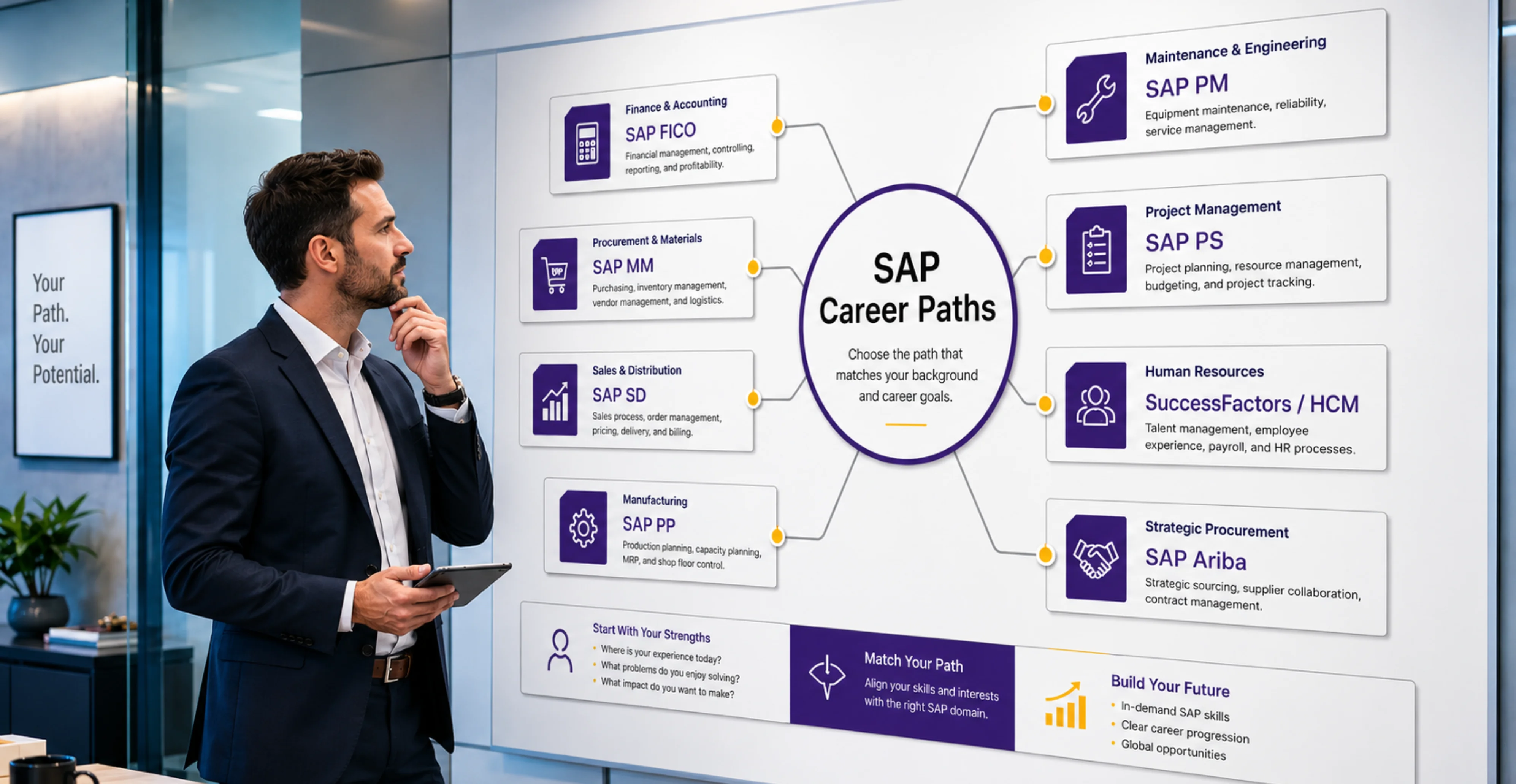
Which SAP Module Should You Learn in 2026? A Complete Career Guide
You have decided that learning SAP could make sense for your professional development. Then the abbreviations start appearing: FICO, MM, SD, PP, PM, PS, HCM, SuccessFactors, Ariba and many more.
The natural question is: which SAP module should I actually learn?
There is no single SAP module that is best for everybody. An accountant and a maintenance engineer may both be complete SAP beginners, yet it would make little sense to recommend exactly the same starting point to both.
A more reliable way to choose is:
BACKGROUND → BUSINESS FUNCTION → EXPERIENCE → CAREER DIRECTION → SAP PATH
Your existing knowledge is not something to leave behind when you enter SAP. In many cases, it is the foundation that makes a particular SAP area understandable.
Finance professionals already recognise financial reporting and accounts processes. Procurement professionals understand suppliers and purchasing. Production planners understand manufacturing constraints. Maintenance engineers understand equipment and work orders.
That professional alignment should come first.
Salary, popularity and vacancies may matter later, but they vary considerably by country, employer, industry, implementation environment and level of experience. They are poor substitutes for choosing a field you can understand and develop in depth.
There is also an important 2026 consideration.
SAP's current ERP direction is centred on SAP S/4HANA and its cloud ERP offerings. SAP states that mainstream maintenance for the core SAP Business Suite 7 applications runs until the end of 2027, with optional extended maintenance until the end of 2030, while at least one SAP S/4HANA release is committed to maintenance through 2040.
SAP S/4HANA 2025 FPS01 was released in February 2026.
For a new learner, this makes current S/4HANA processes and terminology more strategically relevant than an ECC-only learning approach built around memorising old screens and transaction codes.
What Is an SAP Module?
An SAP module, in everyday career language, is a specialised area of SAP associated with a particular set of business processes or technical responsibilities.
Finance users work with accounting processes. Procurement teams deal with requisitions, purchase orders, suppliers and material movements. Sales teams deal with customer orders, deliveries and billing. Manufacturing teams plan materials, capacity and production. Maintenance teams manage equipment and maintenance work.
This is why SAP career specialisations often correspond closely to real organisational departments.
Some familiar names, such as SAP MM, SAP SD and SAP PM, remain widely used by employers, professionals and learners.
SAP's current S/4HANA documentation increasingly uses business-capability terminology such as Sourcing and Procurement, Sales, Manufacturing and Asset Management. Similarly, SAP PS appears within SAP S/4HANA Enterprise Portfolio and Project Management material.
Learning both the established career terminology and the current S/4HANA terminology helps you understand job discussions without treating older module labels as the complete modern product structure.
At a broad level, SAP career paths can also be divided into functional and technical directions.
Functional specialists concentrate primarily on business processes, requirements and system configuration.
Technical specialists concentrate more heavily on development, extensions, integrations, data and platform architecture.
Some roles sit between the two.
Which SAP Module Is Best in 2026?
The best SAP module in 2026 is the one that most closely matches the business function you understand or genuinely want to build expertise in.
As a practical starting point:
- Accounting and Finance: SAP FICO / SAP Finance
- Procurement and Purchasing: SAP MM / Sourcing and Procurement
- Supply Chain: SAP MM, SD or PP depending on your responsibilities
- Sales and Distribution: SAP SD / SAP S/4HANA Sales
- Manufacturing and Production: SAP PP / Manufacturing
- Mechanical Engineering and Maintenance: SAP PM / Asset Management
- Project Management: SAP PS / EPPM Project System
- Human Resources: SAP HCM or SAP SuccessFactors
- Strategic Procurement: SAP Ariba
- SME ERP and General Business Operations: SAP Business One
These are starting points rather than fixed rules.
SAP's own learning material reinforces these process boundaries. Financial Accounting learning covers areas such as General Ledger, Accounts Payable, Accounts Receivable, Asset Accounting, closing and reporting.
S/4HANA Sourcing and Procurement covers requisitions, purchase orders, goods receipts and invoices.
Sales learning follows order-to-cash processes.
Manufacturing material includes MRP and production planning.
Asset Management covers technical objects and maintenance work.
The mistake is turning these recommendations into a universal ranking.
An accountant who dislikes finance systems may eventually choose another field. A mechanical engineer working in procurement rather than maintenance may find MM more relevant than PM.
Your actual responsibilities matter more than your degree title alone.
How to Choose the Right SAP Module
A useful SAP career decision starts with five questions.
1. What Is Your Educational Background?
Academic knowledge can provide useful context.
Accounting graduates understand ledgers and financial statements.
Supply-chain graduates understand procurement and inventory concepts.
Engineers may already understand plants, manufacturing, equipment or projects.
Computer science graduates may be more naturally drawn towards development, integrations, data or platform work.
Education is a signal, not a rule.
Once you have professional experience, what you actually do at work often becomes more important.
2. What Professional Experience Do You Already Have?
Ask yourself:
Which business problems do people already expect me to understand?
An accountant who handles financial reporting already has domain knowledge relevant to SAP Finance.
A buyer who creates purchasing documents and coordinates suppliers already understands part of procure-to-pay.
A maintenance engineer responsible for preventive work understands concepts that translate naturally into enterprise asset management.
That domain knowledge can reduce the amount of business context you need to learn from zero.
3. Which Business Processes Do You Understand?
This is often the most useful factor.
Instead of asking only, “Which SAP module is popular?”, ask:
What happens before my work begins, what do I do, what happens afterwards, and which departments depend on my output?
That question exposes the process chain behind SAP.
A procurement officer may see the sequence from internal requirement through purchase order, receipt and supplier invoice.
A finance professional may understand what happens when invoices, payments, assets and reporting processes interact.
A maintenance professional may understand how an equipment problem becomes a notification, work order, spare-parts requirement and completed maintenance activity.
Understanding the underlying process makes learning the SAP system far more meaningful.
4. Which Industry Do You Work In?
The same qualification can lead towards different SAP areas depending on the operating environment.
A mechanical engineer in a process plant may work extensively with equipment maintenance, making Asset Management or PM highly relevant.
A mechanical engineer in a production-planning role may be closer to PP.
One assigned to capital projects may encounter PS.
An engineer managing materials and vendors could move towards MM.
Your industry and responsibilities can change which SAP path makes the most sense.
5. Where Do You Want Your Career to Go?
Finally, consider what kind of problems you want to solve.
Do you want to remain close to:
- Finance?
- Procurement?
- Production?
- Sales?
- Maintenance?
- HR?
- Project delivery?
- Software engineering?
- Data and integration?
A sensible SAP career path normally builds on a coherent professional story:
This is the business domain I understand, these are the processes I have learnt, and this is how I apply SAP to them.
Best SAP Modules Based on Your Professional Background
Accounting and Finance Professionals: SAP FICO
For accountants, finance graduates, auditors, management accountants and professionals working with financial reporting, SAP FICO is usually the most natural functional starting direction.
“FICO” remains common industry shorthand for Financial Accounting and Controlling.
In current SAP S/4HANA learning material, SAP more often presents these capabilities as Financial Accounting and Management Accounting.
Financial Accounting covers areas such as:
- Organisational units and master data
- General Ledger
- Accounts Payable
- Accounts Receivable
- Asset Accounting
- Financial closing
- Financial reporting
Management Accounting includes areas such as overhead cost accounting, product costing and profitability-related processes.
A finance professional therefore has an immediate conceptual advantage.
Terms such as posting, account, receivable, payable, asset, period close, cost centre and profitability are business concepts rather than purely SAP concepts.
FICO also illustrates why integration matters.
Supplier invoices may originate from purchasing processes, while customer billing can create accounting entries automatically.
SAP documentation describes the connection between Sales and Financial Accounting, including accounting documents generated through goods issue and billing processes.
Consider SAP FICO when your work is primarily about accounting, financial operations, reporting, receivables, payables, asset accounting, cost management or financial control.
Procurement and Supply Chain Professionals: SAP MM
For purchasing officers, procurement specialists, inventory professionals, materials planners and many supply-chain professionals, SAP MM is a strong starting point.
In contemporary SAP S/4HANA material, much of what professionals traditionally associate with MM appears under Sourcing and Procurement.
SAP's procurement learning content covers areas such as:
- Material and supplier master data
- Purchase requisitions
- Purchase orders
- Goods receipt
- Supplier invoices
- Inventory-related processes
- Different procurement scenarios
A typical process can look like this:
Requirement → Purchase Requisition → Purchase Order → Goods Receipt → Supplier Invoice
That process immediately connects several teams.
Procurement creates or manages purchasing documents.
Warehouse or receiving functions confirm physical receipt.
Finance handles the supplier liability and eventual payment.
Production may have generated the material requirement in the first place.
MM is therefore especially suitable for people who understand suppliers, purchasing, materials, inventory, receiving or operational procurement.
It also integrates closely with Finance, Production Planning, Sales and Asset Management.
That is why supply-chain professionals benefit from learning neighbouring process relationships rather than treating MM as an isolated system.
Sales and Distribution Professionals: SAP SD
For professionals working in sales operations, order management, distribution, customer fulfilment or billing coordination, SAP SD, now commonly encountered through SAP S/4HANA Sales terminology, is the natural functional direction to investigate.
A stock sales process can progress through:
Customer Demand → Sales Order → Fulfilment → Delivery → Goods Issue → Billing
Goods issue can update inventory and create Financial Accounting consequences, while billing creates entries related to revenue and customer receivables.
SD therefore suits professionals whose work revolves around customers, commercial processes and fulfilment.
A capable SAP Sales professional needs to understand more than data-entry screens.
Important areas include:
- Customer and business-partner data
- Sales orders
- Pricing
- Availability
- Fulfilment
- Shipping
- Delivery
- Goods issue
- Billing
- Financial integration
Manufacturing and Production Professionals: SAP PP
For production planners, manufacturing professionals, industrial engineers and operations specialists, SAP PP / SAP S/4HANA Manufacturing is usually the area to examine first.
SAP's current production-planning material covers demand, material requirements planning, capacity considerations and production orders.
MRP calculates how requirements can be covered, while production planning connects material availability, dates and production resources.
SAP PP is particularly relevant when your professional questions sound like:
- What must be produced?
- In what quantity?
- By when?
- Which materials are needed?
- Are those materials available?
- Is production capacity available?
- How should the production order be executed?
This is also why SAP MM vs SAP PP should not be viewed as a competition between two unrelated modules.
MM focuses heavily on obtaining and managing materials.
PP focuses on planning and executing production.
In manufacturing organisations, one frequently depends on the other.
Mechanical Engineers and Maintenance Professionals: SAP PM
For mechanical engineers working around plant equipment, reliability, maintenance planning, workshops or industrial assets, SAP PM is often one of the strongest professional alignments.
In current S/4HANA terminology, SAP primarily presents these capabilities as SAP S/4HANA Asset Management.
The relevant processes include areas such as:
- Equipment
- Functional locations
- Technical objects
- Maintenance notifications
- Maintenance orders
- Preventive maintenance
- Maintenance planning
An engineer who already works with equipment history, breakdowns, inspections, preventive maintenance, work orders or spare parts can therefore bring substantial domain knowledge into SAP.
However, PM is not automatically the right answer for every mechanical engineer.
A production-focused engineer may fit PP.
A project engineer may benefit more from PS.
A materials or procurement role may point towards MM.
Your job function should decide, not your engineering degree alone.
Project Managers and Project Professionals: SAP PS
Professionals responsible for structured projects, budgets, project costs, schedules and execution should investigate SAP PS, or SAP S/4HANA EPPM Project System.
Relevant areas include:
- Work Breakdown Structures
- Cost planning
- Budgeting
- Project execution
- Project-related procurement
- Actual costs
- Period-end activities
- Settlement
SAP PS can therefore make sense for project managers, project controllers, project engineers and professionals working in capital investment or project-based environments.
The strongest fit comes when you understand how projects are planned financially and operationally, rather than only possessing a generic project-management title.
HR Professionals: SAP HCM and SAP SuccessFactors
HR professionals need a more careful decision because SAP HCM and SAP SuccessFactors are related but are not interchangeable names for the same thing.
SAP HCM for S/4HANA continues to cover established HR processes such as organisational management, time and payroll-related capabilities.
SAP SuccessFactors is SAP's cloud human-experience-management portfolio, with Employee Central serving as a core cloud HR system for organisational and employee data.
SAP also documents integration and hybrid scenarios between SuccessFactors Employee Central and SAP HCM for S/4HANA.
For an HR professional, the choice therefore depends partly on the organisation and target environment.
If your work centres on an existing SAP HCM landscape, payroll, time or related on-premise or hybrid HR operations, HCM knowledge may be directly relevant.
If you are moving towards cloud HR transformation, Employee Central and the wider SuccessFactors environment may be more appropriate.
Do not choose between them based solely on which name appears newer.
Understand the HR process and deployment environment you expect to work with.
Procurement Transformation Professionals: SAP Ariba
SAP Ariba becomes particularly relevant when procurement professionals move beyond operational material purchasing into strategic sourcing, supplier-facing processes, guided buying and procurement transformation.
SAP Ariba Sourcing supports areas such as:
- Sourcing events
- Supplier participation
- Sourcing rules
- Bidding
- Evaluation
- Award scenarios
SAP also provides Ariba Buying and Invoicing capabilities across procurement and invoice-related processes.
This makes SAP Ariba worth considering for:
- Strategic sourcing professionals
- Category-management teams
- Procurement transformation specialists
- Supplier collaboration professionals
- Professionals working with digital procurement environments
Ariba should not simply be presented as “the new MM”.
Their scopes overlap in procurement, but the solutions address different parts of the wider sourcing, purchasing and supplier ecosystem and can operate together.
SAP Functional vs Technical: Which Path Should You Choose?
Choose a functional SAP path when your strongest asset is understanding how a business function operates. Consider a technical path when your strengths and interests centre more on software, integrations, data, extensions or architecture.
Neither path is inherently better.
Functional SAP work can include:
- Understanding and mapping business processes
- Gathering and analysing requirements
- Configuring relevant system behaviour
- Discussing requirements with business stakeholders
- Preparing and performing functional testing
- Supporting process design
- Understanding integration with neighbouring functions
Technical work can include:
- Software development
- Application extensions
- APIs
- System integrations
- Data-related work
- Platform architecture
The exact role varies significantly across SAP environments.
A finance graduate with accounting experience therefore has an obvious reason to investigate functional Finance before assuming they need to become a programmer.
A computer science graduate who enjoys software engineering may instead investigate technical development and platform-related directions.
There are also hybrid careers.
An integration specialist needs enough functional knowledge to understand what connected systems are doing.
A strong functional consultant needs enough technical awareness to communicate effectively with technical teams.
Which SAP Module Is Best for Beginners?
There is no universal “best SAP module for beginners” because being a beginner describes your SAP experience, not your professional background.
A beginner accountant and beginner maintenance engineer are both new to SAP.
Yet FICO may be far more intuitive for the accountant, while PM or Asset Management may make considerably more sense for the maintenance engineer.
The better beginner question is:
Which SAP business process do I already understand well enough to recognise what the system is trying to achieve?
Starting with familiar domain concepts reduces unnecessary complexity.
You can then concentrate on understanding how SAP represents and connects that process.
Ease of learning also depends on your starting knowledge, access to practice, quality of instruction, the depth you are trying to achieve and the complexity of the business scenarios involved.
Treat claims that one module is universally “the easiest SAP module” with caution.
Which SAP Module Is Best for Fresh Graduates?
Fresh graduates have less work experience to use as a guide, so academic discipline, internships, projects and genuine professional interests become more important.
Here are some useful starting directions.
Accounting Graduates
Explore SAP FICO / SAP Finance because of its close relationship with accounting, financial reporting and financial-control concepts.
Commerce Graduates
Possible directions include FICO, MM or SD.
The correct choice depends on whether your interests and knowledge are stronger in finance, purchasing, supply chain, sales or commercial operations.
Business Administration Graduates
Possible directions include:
- SAP FICO
- SAP MM
- SAP SD
- SAP SuccessFactors
- SAP PS
Business degrees are broad, so choosing the business function you understand best is more useful than choosing simply according to the degree title.
Supply Chain Graduates
Explore areas such as:
- SAP MM for procurement and materials
- SAP PP for production planning
- SAP SD for customer fulfilment and distribution
- SAP Ariba for strategic sourcing and procurement transformation
Mechanical and Industrial Engineering Graduates
Potential directions include:
- SAP PM for maintenance and asset management
- SAP PP for manufacturing and production
- SAP PS for project-based work
- SAP MM for materials and procurement
The correct path depends heavily on your practical exposure.
HR Graduates
SAP SuccessFactors and SAP HCM are the closest functional directions, particularly for professionals interested in employee, organisational, time, payroll or cloud HR processes.
Computer Science and IT Graduates
Technical SAP paths involving development, integrations, data and platforms may make good use of an existing technical foundation.
Functional areas can also be explored where strong business-process knowledge exists.
A commerce graduate should not pick FICO simply because other commerce graduates do.
Likewise, learning SAP after graduation is entirely possible, but training completion is not the same as possessing project experience.
A new graduate still needs to develop practical process understanding, communication, analytical capability and exposure to realistic scenarios.
Which SAP Module Is Best for Accountants?
SAP FICO is normally the strongest starting direction for accountants because its underlying business processes align directly with financial accounting and management accounting.
Current SAP S/4HANA Finance learning includes:
- General Ledger
- Accounts Payable
- Accounts Receivable
- Asset Accounting
- Closing
- Reporting
These areas map naturally to established accounting responsibilities.
However, a useful Finance learner should not stop at accounting entries.
You should also understand where transactions originate.
A supplier invoice may relate to procurement.
Customer billing can originate from Sales.
A project can accumulate costs that later require financial treatment.
These integrations are central to understanding enterprise finance in SAP.
Which SAP Module Is Best for Mechanical Engineers?
SAP PM / SAP S/4HANA Asset Management is often the most natural choice for mechanical engineers who work with equipment, maintenance planning, breakdowns, preventive maintenance and industrial assets.
SAP represents many of these operational concepts through technical objects, notifications, maintenance orders and maintenance plans.
However, your actual role can change the answer.
- Maintenance and reliability: PM / Asset Management
- Production planning: PP
- Purchasing, inventory or materials: MM
- Capital or engineering projects: PS
A mechanical engineering qualification tells you what technical foundation someone has.
Their work tells you which SAP process they are most likely to understand.
Which SAP Module Is Best for Supply Chain Professionals?
Supply-chain professionals should choose according to the part of the supply chain they actually manage.
If your work revolves around supplier purchasing and inventory, investigate SAP MM.
If you work with customer orders, fulfilment and distribution, investigate SAP SD.
If your responsibilities centre on manufacturing requirements and production, investigate SAP PP.
If you work with strategic sourcing, supplier events or procurement transformation, investigate SAP Ariba.
These domains intersect.
A supply-chain professional therefore benefits from choosing one primary specialisation while understanding the adjacent process chain.
Which SAP Module Is Best for HR Professionals?
HR professionals should generally investigate SAP SuccessFactors and SAP HCM, then choose according to the HR processes and system landscape they expect to work with.
SuccessFactors Employee Central is a cloud core-HR environment.
SAP HCM for S/4HANA supports established HCM scenarios.
SAP also supports integrated and hybrid landscapes involving the two.
Someone working primarily with cloud HR transformation may reasonably prioritise SuccessFactors Employee Central.
Someone supporting payroll, time or an established HCM for S/4HANA environment may require SAP HCM knowledge.
HR specialisation also matters.
Recruiting, employee data, time, payroll and talent processes are not one identical skill set.
SAP FICO vs SAP MM
SAP FICO and SAP MM solve fundamentally different business problems.
What Does SAP FICO Focus On?
SAP FICO primarily focuses on Finance and Management Accounting.
It commonly fits:
- Accountants
- Finance professionals
- Management accountants
- Commerce graduates with strong accounting knowledge
- Professionals involved in financial operations
Typical areas include:
- General Ledger
- Accounts Payable
- Accounts Receivable
- Asset Accounting
- Financial closing
- Reporting
- Management Accounting
FICO commonly integrates with MM, SD, PS and other business functions that generate financial consequences.
What Does SAP MM Focus On?
SAP MM focuses primarily on procurement, materials and inventory processes.
It commonly fits:
- Buyers
- Procurement professionals
- Supply-chain professionals
- Inventory professionals
- Materials-management staff
Typical areas include:
- Purchase requisitions
- Purchase orders
- Supplier processes
- Goods receipt
- Materials
- Inventory
- Supplier invoice integration
MM commonly integrates with FICO, PP, SD and PM.
Should You Choose SAP FICO or SAP MM?
Choose FICO if your strongest professional foundation is finance, accounting, reporting or financial control.
Choose MM if your strongest foundation is purchasing, suppliers, materials or inventory.
The two often meet during procure-to-pay.
A goods receipt and supplier invoice can create accounting effects, connecting procurement operations to Finance.
There is therefore no meaningful universal winner in SAP FICO vs SAP MM.
Choose the business domain that fits you.
SAP MM vs SAP SD
SAP MM is primarily the procurement-and-materials direction, while SAP SD is primarily the sales-and-customer-fulfilment direction.
Think of them as two different sides of enterprise flow.
SAP MM asks: How does the organisation obtain the materials or services it needs?
SAP SD asks: How does the organisation fulfil demand and bill its customers?
MM commonly involves:
- Purchase requisitions
- Purchase orders
- Receiving
- Inventory
- Supplier invoices
SD commonly involves:
- Sales orders
- Deliveries
- Goods issue
- Customer fulfilment
- Billing
Choose MM if your professional world revolves around suppliers and inbound materials.
Choose SD when it revolves around customers, sales orders and outbound fulfilment.
Professionals working across logistics may eventually need awareness of both.
SAP MM vs SAP PP
SAP MM focuses on materials and procurement, while SAP PP focuses on planning and executing production.
The right choice usually becomes clearer when you ask whether your work is primarily concerned with acquiring materials or turning materials and capacity into finished output.
A production plan creates demand for components.
MRP can lead to planned production or external procurement requirements, demonstrating the close relationship between production planning and purchasing.
A buyer working with suppliers normally starts with MM.
A production planner responsible for MRP, schedules and production orders normally starts with PP.
A manufacturing supply-chain professional may eventually need a strong understanding of both.
Should You Learn More Than One SAP Module?
Beginners usually gain more from becoming genuinely capable in one primary area than from collecting shallow exposure to several modules.
Once your main process is clear, expand into the integrations that affect it.
Useful combinations include:
SAP FICO + SAP MM
Procurement creates financial consequences such as supplier liabilities and inventory-related postings.
SAP FICO + SAP SD
Sales billing and goods issue can create Financial Accounting postings.
SAP MM + SAP PP
Production requirements drive material planning and procurement.
SAP MM + SAP SD
Inventory and material availability can affect customer fulfilment.
SAP PM + SAP MM
Maintenance work may require spare parts, materials and externally procured services.
SAP PS + SAP FICO
Projects require cost planning, budgeting, actual-cost control and settlement.
This does not mean you must become an implementation-level expert in every connected area.
A strong MM professional should understand what Finance needs from procurement.
That does not automatically make them a FICO consultant.
A good SAP career develops depth first, then relevant breadth.
Understanding SAP Integration Is More Valuable Than Memorising Screens
Enterprise processes rarely stop at departmental boundaries.
That is one reason SAP expertise cannot be reduced to knowing where buttons are located.
Consider a simplified procurement process:
Purchase Requisition → Purchase Order → Goods Receipt → Supplier Invoice → Payment
Several professional perspectives are involved.
Requirement: An internal team identifies a need.
Purchase Order: Procurement formalises purchasing with the supplier.
Goods Receipt: The receiving or warehouse function confirms delivery.
Invoice: The supplier's invoice is checked and posted.
Payment: Finance settles the resulting liability according to the relevant process.
Now consider the sales side:
Sales Order → Delivery → Goods Issue → Billing → Financial Posting
When goods issue is posted, inventory and accounting consequences can occur.
Billing creates customer-receivable and revenue-related accounting consequences.
A learner who only memorises the screen used to post a goods issue understands less than someone who can explain:
- Why the goods issue exists
- Which physical event it represents
- Which document preceded it
- What happens to inventory
- What accounting consequence follows
- What the next business step is
This is where Avision Trainings' UNDERSTAND → PRACTICE → APPLY philosophy becomes particularly relevant.
UNDERSTAND the real business process and why it exists.
PRACTICE the sequence, master data, decisions and system behaviour through realistic scenarios.
APPLY the knowledge by analysing what should happen when conditions, requirements or business problems change.
That progression is more professionally meaningful than treating SAP as a collection of screens to memorise.
SAP S/4HANA vs SAP ECC: What Should a New Learner Focus On?
For someone beginning in 2026, SAP S/4HANA should be the primary reference point.
That does not mean ECC knowledge has suddenly become worthless.
Many organisations still operate older SAP ERP landscapes, and migration projects may require professionals to understand legacy processes.
However, SAP's published maintenance strategy gives Business Suite 7 core applications mainstream maintenance through the end of 2027, followed by optional extended maintenance through 2030, while SAP has committed to maintaining at least one SAP S/4HANA release through 2040.
SAP also continues to release S/4HANA functionality, with SAP S/4HANA and SAP S/4HANA Cloud Private Edition 2025 FPS01 released in February 2026.
The practical lesson is not “ignore ECC”.
It is:
Do not build a new SAP career around ECC-era transaction memorisation while overlooking S/4HANA business processes, SAP Fiori, current terminology and modern deployment environments.
How Long Does It Take to Learn SAP?
There is no credible universal answer to how long it takes to “learn SAP” because the word learn can describe very different levels of capability.
Understanding basic terminology is not the same as configuring a process, solving integration problems or working independently on a complex implementation.
A useful way to think about progress is through stages.
Fundamentals
Understand SAP, ERP concepts and the purpose of your chosen business area.
Business-Process Understanding
Explain the process end to end without relying on the software interface.
System Understanding
Recognise organisational structures, master data, documents and process relationships.
Practical Execution
Work through realistic business scenarios rather than isolated demonstrations.
Configuration Understanding
Where appropriate to the role, learn why settings produce particular process behaviour.
Integration Understanding
Know what your process sends to and receives from neighbouring SAP areas.
Project Exposure
Experience requirements, testing, defects, change, data issues, stakeholder discussions and real organisational constraints.
Professional Competence
Develop the ability to solve problems reliably within your particular role and environment.
A training programme can accelerate the earlier stages and provide structured practice.
It cannot legitimately turn a learner into an experienced consultant merely because the programme has ended.
How to Start Learning SAP
A practical progression is:
Start With the Business Process
Before touching detailed configuration, learn what the function is trying to achieve.
Choose One Primary SAP Direction
Use your background and career goals instead of trying to learn every module.
Build SAP S/4HANA Foundations
Understand the ERP environment, current user experience and how end-to-end enterprise processes connect.
Learn Organisational Structures
Understand how the relevant SAP area represents companies, plants, purchasing organisations, sales structures and other organisational entities.
Learn the Master Data That Drives Your Process
Transactions only make sense when you understand the underlying materials, business partners, accounts, equipment, employees or other master data.
Follow the End-to-End Process
Learn what triggers the process, the sequence of documents, the people involved and the business outcome.
Practise Scenarios Repeatedly
A learner should be able to explain not only what they clicked, but what happened and why.
Study Configuration Concepts Where Appropriate
Functional consulting requires understanding how process behaviour is designed, not simply how a business user performs a transaction.
Learn Integration
Trace the hand-offs to other functions.
Complete Realistic Exercises or Projects
Practice should contain decisions, errors and variations rather than a single perfect demonstration.
Continue Developing Business and Consulting Knowledge
Communication, requirement analysis, testing, documentation and stakeholder understanding matter alongside product knowledge.
Common Mistakes When Choosing an SAP Module
Choosing a Module Only Because Someone Says It Pays More
Compensation and opportunity vary by geography, seniority, industry, employer, implementation environment and actual expertise.
The “highest-paying SAP module” is not a reliable career-selection method.
Following Friends Into an Unrelated Module
Your friend's accounting background may make FICO logical for them while your maintenance experience makes PM far more coherent for you.
Trying to Learn Four Modules at Once
Trying to learn several modules simultaneously can produce vocabulary without depth.
Build one professional foundation and then learn the integrations that matter.
Ignoring Experience You Already Possess
A procurement professional may have spent years learning business concepts that a new procurement consultant needs to understand.
Starting SAP does not reset that knowledge to zero.
Choosing Purely on Module Popularity
Popularity does not guarantee fit, competence or opportunity in your market.
Confusing Screen Memorisation With Process Understanding
Interfaces can change.
Business logic, dependencies and controls are the deeper capability.
Ignoring Integration
SAP processes work across functional boundaries.
Understanding how your area connects to neighbouring functions can be just as important as understanding the individual steps within your own area.
Expecting Training to Replace Experience
Professional training can build knowledge and practical capability.
Real professional experience develops as that capability is applied within increasingly complex organisational environments.
SAP Modules Compared by Career Direction
If you still need a quick comparison, think about the modules according to the business problems they solve.
SAP FICO
Primary business area: Finance and controlling
Suitable backgrounds: Accounting, finance and commerce
Typical processes: General Ledger, Accounts Payable, Accounts Receivable, Asset Accounting, closing, reporting and management accounting
Common integrations: MM, SD and PS
Best suited to: Accountants, finance professionals and professionals involved in financial control and reporting
SAP MM / Sourcing and Procurement
Primary business area: Procurement, materials and inventory
Suitable backgrounds: Procurement, supply chain, inventory and purchasing
Typical processes: Purchase requisitions, purchase orders, goods receipt, material and supplier processes and supplier-invoice integration
Common integrations: FICO, PP, SD and PM
Best suited to: Buyers, procurement specialists, inventory professionals and materials-management professionals
SAP SD / SAP S/4HANA Sales
Primary business area: Sales and distribution
Suitable backgrounds: Sales operations, logistics and commercial roles
Typical processes: Sales orders, delivery, goods issue, fulfilment and billing
Common integrations: FICO and MM
Best suited to: Sales, order-management and customer-fulfilment professionals
SAP PP / Manufacturing
Primary business area: Manufacturing and production
Suitable backgrounds: Production planning, industrial engineering, manufacturing and operations
Typical processes: MRP, production planning, production orders and capacity-related processes
Common integrations: MM, SD and Finance
Best suited to: Production planners and manufacturing professionals
SAP PM / Asset Management
Primary business area: Maintenance and enterprise assets
Suitable backgrounds: Mechanical engineering, maintenance and reliability
Typical processes: Equipment, functional locations, maintenance notifications, maintenance orders and preventive maintenance
Common integrations: MM and Finance
Best suited to: Maintenance engineers, plant professionals and reliability teams
SAP PS / EPPM Project System
Primary business area: Project management
Suitable backgrounds: Project managers, project engineers and project controllers
Typical processes: WBS, planning, budgets, execution, costs and settlement
Common integrations: FICO and MM
Best suited to: Professionals working within structured project-based environments
SAP HCM
Primary business area: Human Resources
Suitable backgrounds: HR, payroll and time-management professionals
Typical processes: HR administration, organisational management, time and payroll-related processes
Common integrations: Finance and SuccessFactors
Best suited to: HR professionals working with SAP HCM or S/4HANA HR environments
SAP SuccessFactors
Primary business area: Cloud HR and Human Experience Management
Suitable backgrounds: HR, HRIS and HR-transformation professionals
Typical processes: Employee Central and wider cloud HR processes
Common integrations: SAP HCM, payroll and other enterprise systems
Best suited to: Professionals targeting cloud HR transformation and modern HR technology environments
SAP Ariba
Primary business area: Strategic procurement, sourcing and buying
Suitable backgrounds: Strategic sourcing, procurement transformation and category management
Typical processes: Sourcing events, supplier participation, evaluation, awards, guided buying and procurement processes
Common integrations: SAP S/4HANA procurement and wider SAP business-network environments
Best suited to: Procurement professionals moving towards strategic sourcing and digital procurement transformation
SAP Business One
Primary business area: Integrated ERP for small and midsize businesses
Suitable backgrounds: SME finance, business systems and ERP generalists
Typical processes: Accounting, purchasing, inventory, sales and reporting
Best suited to: Professionals working with small and midsize ERP environments where broader cross-functional knowledge is valuable
It is important to understand that SAP Business One is a separate ERP product, not simply another SAP S/4HANA functional module.
SAP positions Business One as an integrated ERP solution for small businesses covering financials, purchasing, inventory, sales and related operations.
A Simple SAP Module Decision Framework
If you want the simplest possible way to narrow down your options, start with the business process you understand best.
Finance, accounting and reporting → SAP FICO / SAP Finance
Purchasing, suppliers and materials → SAP MM / Sourcing and Procurement
Customers, orders and distribution → SAP SD / SAP S/4HANA Sales
Manufacturing and production planning → SAP PP / Manufacturing
Equipment, reliability and maintenance → SAP PM / Asset Management
Projects, budgets and project execution → SAP PS / EPPM Project System
HR and workforce processes → SAP HCM or SAP SuccessFactors
Strategic sourcing and supplier transformation → SAP Ariba
Software, integrations, APIs or data → Explore a technical SAP path
Then apply a second test:
Can I explain the underlying business process without SAP?
If yes, you may already possess useful domain knowledge.
If no, learn that process before assuming the software alone will make you professionally capable.
Frequently Asked Questions
Which SAP Module Is Easiest to Learn?
There is no universally easiest SAP module.
Difficulty depends heavily on your existing knowledge.
FICO may feel intuitive to an experienced accountant but unfamiliar to a mechanical engineer.
PM may make immediate sense to a maintenance professional but not to somebody who has never worked with industrial equipment.
Choose professional alignment over an “easiest module” ranking.
Which SAP Module Is Best for Beginners?
The best beginner module is usually the one closest to the business function you already understand.
Accountants can investigate FICO, procurement professionals MM, sales professionals SD, manufacturing professionals PP, maintenance professionals PM and HR professionals HCM or SuccessFactors.
Being new to SAP does not erase your existing professional expertise.
Which SAP Module Has the Best Career Potential?
No responsible answer can identify one module as universally having the best career potential across every country and industry.
Career potential depends on local employers, industry concentration, implementation activity, your experience, the specific SAP environment and how well you can solve business problems.
Choose an aligned specialisation first, then research demand in the geography and industries where you intend to work.
Can a Fresher Learn SAP?
Yes.
A fresh graduate can begin learning SAP, particularly when the chosen direction builds on academic knowledge such as accounting, supply chain, engineering, HR or computer science.
The important limitation is that training and practice do not automatically create implementation experience.
Fresh graduates should treat learning as the beginning of capability development rather than proof that they are already experienced consultants.
Which SAP Module Is Best for Accountants?
SAP FICO is normally the strongest starting direction.
SAP S/4HANA Financial Accounting covers areas such as General Ledger, Accounts Payable, Accounts Receivable, Asset Accounting, closing and reporting, making the relationship with accounting work particularly direct.
Which SAP Module Is Best for Mechanical Engineers?
SAP PM / SAP S/4HANA Asset Management is especially relevant to mechanical engineers involved in equipment and maintenance.
PP may be better for production planning, PS for project work and MM for procurement or materials responsibilities.
Which SAP Module Is Best for Supply Chain Professionals?
It depends on which part of the supply chain you manage.
Procurement and materials usually point towards MM.
Production planning points towards PP.
Sales fulfilment points towards SD.
Strategic sourcing and procurement transformation may point towards SAP Ariba.
Should I Choose SAP FICO or SAP MM?
Choose FICO if your strongest domain is finance and accounting.
Choose MM if your strongest domain is procurement, materials or inventory.
Do not choose based on a generic salary comparison.
These functions solve different business problems, although they integrate closely in processes such as procure-to-pay.
Can I Learn Two SAP Modules?
Yes, but beginners generally benefit from developing depth in one primary area first.
Once that foundation is established, learn the adjacent integration most relevant to your work, such as:
- MM and FICO
- MM and PP
- SD and FICO
- PM and MM
- PS and FICO
Understanding an integration does not require claiming equal expertise in both modules.
Do I Need Programming Knowledge to Learn SAP?
Not for every SAP career.
Many functional areas rely primarily on understanding business processes, configuration, requirements, testing and stakeholder communication.
Technical development, integrations and some platform roles require a different technical skill set.
Your SAP direction should determine how much programming knowledge you need, not the other way around.
Is SAP Suitable for Non-IT Professionals?
Yes.
Much of enterprise SAP work is organised around business functions including finance, purchasing, sales, manufacturing, maintenance, projects and HR.
SAP's own learning ecosystem structures many learning journeys around these business processes.
Non-IT professionals still need to develop systems thinking and learn the SAP environment, but their functional experience can be a major advantage.
Is SAP S/4HANA Difficult to Learn?
SAP S/4HANA is a broad enterprise system, so learning the entire platform is not a realistic beginner objective.
Learning becomes more manageable when you narrow the scope to:
- One business function
- Its organisational structure
- Its master data
- One end-to-end process
- Its most important integrations
Professional competence then develops through progressive practice and exposure.
How Should I Choose Between Functional and Technical SAP?
Choose a functional direction when you want to specialise primarily in business processes, configuration and business requirements.
Explore technical SAP when your interests and strengths are more strongly connected to software development, integrations, APIs, data or architecture.
People with strengths in both may eventually work in roles that bridge business and technology.
Choosing the SAP Path That Fits Your Career
The best SAP module is not necessarily the module that appears most often in a social-media discussion, the module your friend chose or the one somebody claims has the highest salary.
It is the SAP direction that makes the strongest professional sense when you consider:
- Your background
- Your experience
- Your industry
- The business processes you understand
- The work you want to do next
An accountant choosing FICO has a coherent starting point.
So does a procurement professional choosing MM, a production planner choosing PP, a maintenance engineer choosing PM, a project professional choosing PS or an HR practitioner choosing SuccessFactors or HCM according to the relevant system environment.
From there, the next step is depth.
Understand the process, practise realistic scenarios and learn how your work connects to neighbouring enterprise functions.
Avision Trainings provides professional SAP training with an emphasis on practical understanding, business processes and workplace-relevant application.
Our learning principle is straightforward:
UNDERSTAND → PRACTICE → APPLY
The objective should not simply be to say that you completed SAP training.
It should be to explain the process you learnt, perform it with understanding and continue building the professional capability required to apply it in real organisational environments.
If your background points towards Finance, you can explore Avision Trainings' SAP S/4HANA FICO Training.
Professionals interested in procurement, Sales, Production Planning, Plant Maintenance, Project System, SuccessFactors, SAP Ariba or SAP Business One should similarly choose the professional training path that most closely matches their existing knowledge and intended career direction.
Choose the process first. Then choose the SAP specialisation that lets you build on it.