

A practical one-day introduction to artificial intelligence for business professionals with no technical background. Learn how generative AI, large language models, image generation, and prompting can support everyday tasks across marketing, sales, operations, customer service, research, and productivity.
Key skills and concepts covered throughout this course.
3 outcomes
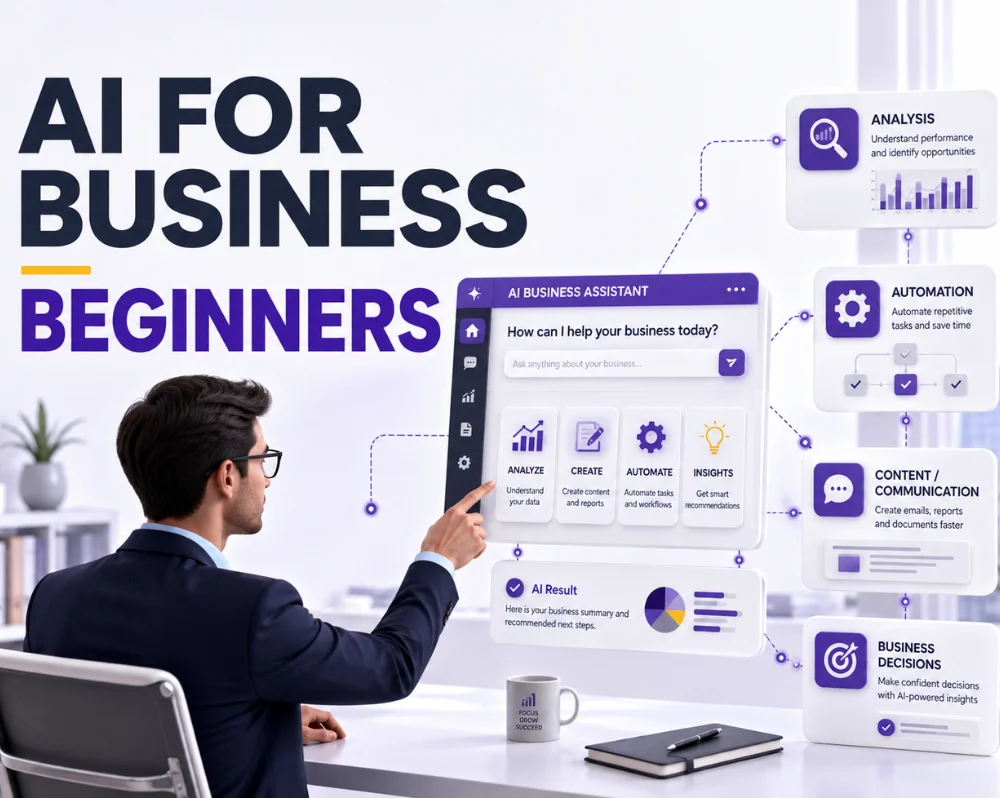
AI for Business Beginners is designed for professionals who want to understand AI without getting buried in technical terminology. The course explains the fundamentals of artificial intelligence, generative AI, large language models, image models, multimodal AI, prompting, and responsible AI use through practical workplace examples.
Participants learn how to use AI for writing and improving business content, creating emails and marketing material, generating social media and website ideas, summarizing information, supporting customer communication, conducting research, developing presentations, and improving day-to-day productivity. No coding, data science, or previous AI knowledge is required.
The training is practical, interactive, demonstration-led, and focused on helping participants identify realistic AI opportunities within their own roles while understanding important issues such as accuracy, hallucinations, privacy, copyright, bias, and responsible AI usage.
Course Contents
Introduction to Artificial Intelligence
What artificial intelligence means in a business environment
Understanding AI without technical jargon
Traditional automation vs. predictive AI vs. generative AI
Where businesses already encounter AI
How AI supports speed, scale, personalization, and productivity
Common examples including chatbots, recommendation systems, AI assistants, and automated reporting
Understanding AI Models
What an AI model is
Text and language models
Image generation models
Speech and voice models
Video generation models
Multimodal AI
How different AI models support different business tasks
Large Language Models and Generative AI
What Large Language Models (LLMs) are
How LLMs generate and transform text
Writing and rewriting content
Summarizing information
Brainstorming and idea generation
Translation and explanation
Information extraction and classification
Understanding terms such as prompts, tokens, context windows, chatbots, copilots, agents, and hallucinations
Understanding what LLMs can and cannot reliably do
Prompting for Better AI Results
What a prompt is
Why prompt quality affects AI output
Using role, task, context, and audience
Defining tone and output format
Adding constraints and examples
Asking AI to shorten, expand, compare, structure, critique, or improve content
Iterative prompting and refining AI responses
Turning weak prompts into effective business prompts
Creating reusable prompt templates
Protecting confidential information when prompting
AI for Business Writing and Copywriting
Creating headlines and marketing copy
Writing product and service descriptions
Developing brochure content
Drafting advertisements
Creating landing page content
Writing FAQs
Developing newsletters
Improving clarity, tone, and structure
Adapting content for different audiences
AI for Emails and Business Communication
Drafting professional emails
Customer follow-up emails
Sales communication
Internal announcements
Reminder emails
Customer updates
Complaint and apology responses
Improving tone and professionalism
Creating clear calls to action
AI for Documents and Business Information
Summarizing reports and documents
Turning rough notes into structured content
Creating SOP drafts
Converting bullet points into proposals
Simplifying technical information
Extracting important information from text
Creating checklists and action items
Structuring business information for easier communication
AI for Social Media and Marketing
Generating social media ideas
Creating captions and hooks
Developing content calendars
Generating campaign themes
Repurposing long-form content into social content
Creating hashtag suggestions
Adapting content to different platforms
Maintaining a consistent brand voice
Avoiding generic AI-generated marketing content
AI for Website Content
Creating homepage content
Writing service and product pages
Developing landing page drafts
Creating website FAQs
Generating blog ideas and outlines
Developing SEO-friendly headings
Improving calls to action
Rewriting existing website content
Adapting website messaging for specific audiences
Image Generation and Visual AI
Understanding image generation models
Business applications of AI-generated imagery
Social media visual concepts
Advertising concepts
Website banners
Presentation and training visuals
Event poster concepts
Product mockups
Storyboards and mood boards
Visual brainstorming
Writing Effective Image Prompts
Defining the main subject
Choosing the setting and environment
Describing visual style
Controlling composition
Specifying lighting
Selecting colors
Setting mood and atmosphere
Choosing aspect ratios
Using negative constraints
Reviewing generated images for quality and brand consistency
AI for Productivity
Creating meeting summaries
Extracting action items
Developing project plans
Building checklists
Assisting with spreadsheets and documents
Creating training plans
Preparing presentation outlines
Organizing business information
Using AI to reduce repetitive administrative work
AI for Research and Decision Support
Summarizing research
Conducting preliminary competitor comparisons
Generating market research questions
Creating interview questions
Brainstorming business ideas
Comparing business options
Identifying potential risks
Generating questions for further investigation
Creating simple decision briefs
Understanding when AI-generated information must be independently verified
AI Applications Across Business Functions
Marketing and content creation
Sales communication and follow-ups
Customer service
Operations and process documentation
HR and administration
Research
Presentations and training
Leadership reporting
Website management
Visual content creation
Responsible AI and Business Risk
Data privacy and confidentiality
Avoiding sensitive-data exposure
Understanding AI hallucinations
Checking facts and claims
Bias and fairness
Copyright and intellectual property considerations
Brand safety
Risks associated with generated images
Human review and approval
Using AI appropriately for customer-facing work
Understanding higher-risk areas such as legal, financial, HR, pricing, contracts, and compliance
Basic principles of organizational AI policies
Practical Workshop: AI Task Finder
Identify repetitive or time-consuming business tasks
Determine where AI could provide useful assistance
Match business tasks with appropriate types of AI
Develop first-prompt ideas
Identify suitable low-risk starting points
Practical Workshop: AI Use-Case Prioritization
Identify potential AI use cases
Evaluate business value
Assess ease of implementation
Consider risk levels
Identify the information or data required
Decide which use cases to start, postpone, or avoid
Select 2–3 practical AI quick wins
Building a Personal AI Action Plan
Select practical AI applications for your role
Start with approved, low-risk AI use cases
Build a personal prompt library
Develop repeatable AI-assisted workflows
Create a review and quality checklist
Track productivity and time savings
Identify the next AI use case to implement
Develop a practical 30-day AI adoption plan
Before you begin
Course requirements
Review the recommended knowledge and tools before joining.
9 requirements
No prior AI knowledge or experience required
No coding, programming, or data science background required
Basic computer and internet browsing skills
Basic familiarity with common business tasks such as email, documents, presentations, or social media
Laptop or desktop computer recommended for hands-on exercises
Internet connection for practical AI demonstrations and activities
Access to an approved AI tool is recommended for hands-on practice
Willingness to experiment with AI using non-confidential business information
The course is specifically designed for non-technical professionals who are completely new to AI.